Fibers Shaping a Cleaner & Healthier Future
We leverage textiles as active, intelligent interfaces solving critical challenges in environment and health.

We leverage textiles as active, intelligent interfaces solving critical challenges in environment and health.
Integrated strategies focused on circular approach, biomass utilization, and responsible process.
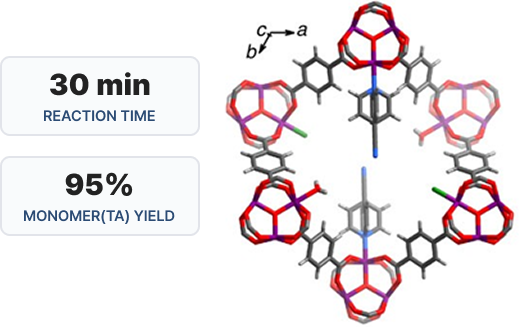


A Sustainable Framework for Advancing Circular Practices for Polyethylene Terephthalate Textiles: Optimized Recycling of Depolymerization Products and LCA Validation. RSC advances (2025).
We develop a sustainable upcycling strategy to transform hard-to-recycle polyethylene terephthalate (PET)/cotton blended fabrics into copper-1,4-benzenedicarboxylate (Cu-BDC) functionalized textiles, redefining both fiber components as value-added material for environmental applications.
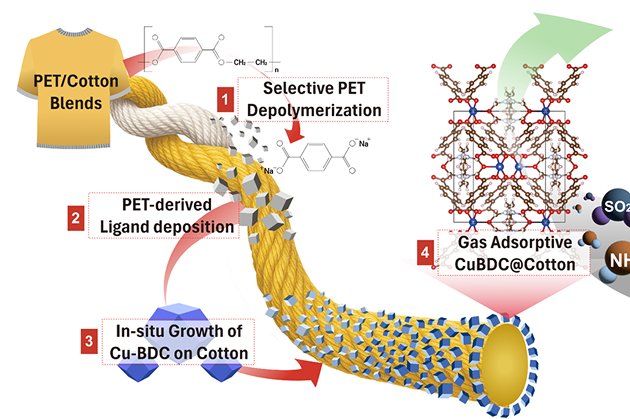
Depolymerized PET becomes the Terephthalate (BDC) ligand for MOF synthesis.
Mercerized cotton serves as a robust structural matrix for in situ MOF growth.
Sustainable upcycling of difficult-to-recycle PET/cotton fabrics into acid-modulated Cu-BDC adsorbents with morphology-driven gas selectivity. Sustainable Materials and Technologies (2026)
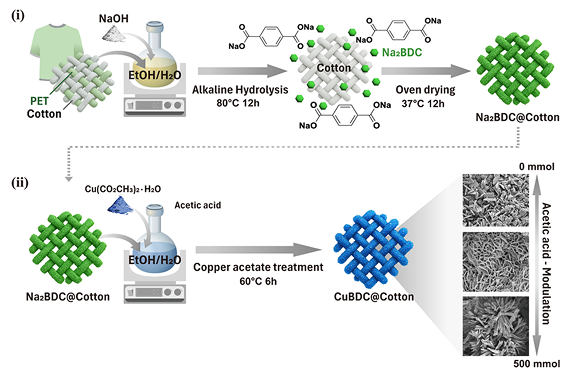
Alkaline hydrolysis (NaOH/EtOH/H₂O) targets the PET fraction, converting it into soluble Na₂BDC ligands with 95% efficiency.
Simultaneously, the cotton fabric undergoes mercerization, activating its surface for functionalization.

The Na₂BDC-coated cotton is treated with Copper Acetate.
This triggers rapid coordination, growing Cu-BDC crystals directly on the fibers (up to 43.1 wt% loading).
Sustainable upcycling of difficult-to-recycle PET/cotton fabrics into acid-modulated Cu-BDC adsorbents with morphology-driven gas selectivity. Sustainable Materials and Technologies (2026)